15% OFF ALL ARTWORKS


 Save
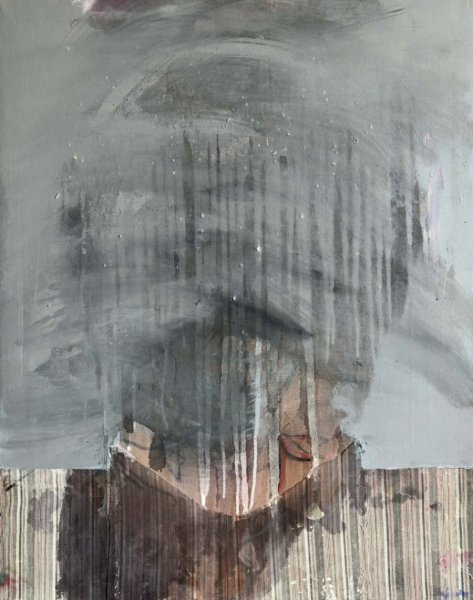
Abstract Portrait in grey


| Year of creation | 2024 |
|---|---|
| Dimensions | 80 W × 100 H × 3 D cm |
| Type of art | painting |
| Style | abstract |
| Genre | portrait |
| Materials | mixed method, fabric |
| Type of packaging | art tube |
Description of the Artwork “Abstract Portrait in grey”
Contemporary abstract portrait 100x80cm
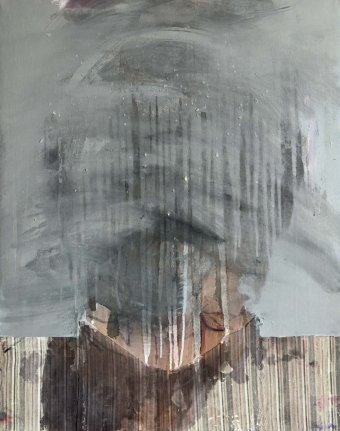
Artwork in the interior


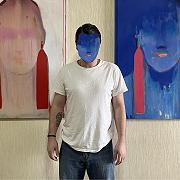
Gela M, Georgia
Gela (b. 1995, Zugdidi, Georgia) Lives and works in Tbilisi Gela is a Georgian visual artist whose practice centers on inherited trauma, material memory, and the long afterlife of collapsed ideologies. Working primarily with biazi—a Soviet-era cotton textile once used to stretch over ceilings in domestic interiors—Mikava reinvents this utilitarian fabric as a politically charged surface. Each piece of biazi, salvaged from abandoned or renovated homes, carries silent traces of a vanished world: adhesive marks, stains, and the residue of an architecture designed for uniformity. Mikava refers to his ongoing body of work as an exploration of Post-Socialist Radiation—a term he coined to describe the invisible yet persistent psychological and aesthetic fallout of Soviet ideology in the post-socialist present. His works do not aim to reconstruct a past, but to trace its lingering frequencies in the present: through faded geometries, spectral figures, ghostlike silhouettes of animals, and the cold palette of concrete cities. Human forms often dissolve into their surroundings; uniforms remain intact while faces blur and disappear—gesturing toward the erasure of individuality under collective memory. Formally trained in painting from a young age, Mikava began painting on biazi out of necessity in early childhood, before its material and political significance had crystallized. What began as pragmatic technique later evolved into critical method: a way of confronting the material remnants of ideology through direct physical engagement. Increasingly, Mikava incorporates inverted or mirrored texts into his compositions—phrases that appear reversed, fragmented, or fading. These textual elements function not as direct communication, but as spectral voices: inner monologues, censored histories, or lost declarations that resist legibility. For Mikava, language becomes a fragile surface, subject to distortion and decay—another vessel for ideological residue. By using fabric that was once nailed to ceilings—designed to cover up the crumbling of time—Mikava exposes what lingers beneath. His work resists nostalgia or clear symbolism; instead, it vibrates with unresolved tension. As a second-generation inheritor of post-socialist trauma, Mikava navigates memory not as a site of mourning, but as a charged, living field—a radiation zone whose signals are still being decoded.